
UN General Assembly endorses ICJ Advisory Opinion on Climate Change

On 20 May 2026, the UN General Assembly — the main deliberative policymaking and representative forum of the United Nations containing all 193 UN members — by overwhelming majority (141 for; 8 against and 28 abstentions) endorsed the landmark advisory opinion of the International Court of Justice from July 2025 on the Obligations of States in Relation to Climate Change.
Among other things, the resolution called on states to comply with the obligations under international law set out by the ICJ, both under the provisions of the UN climate treaties (such as the UN Framework Convention on Climate Change and Paris Agreement) and legal obligations under customary international law. The 20 May resolution has been hailed as 'turning point in global climate leadership' (WWF); 'a major shift for climate justice' (Pacific Islands Students Fighting Climate Change); 'highly problematic' (US Mission to the United Nations) and 'a welcome step', but 'flawed' (Climate Rights International)
Which of these is it? How significant is the resolution to global climate change law and policy?
The resolution is significant: politically, diplomatically and legally. But its impact on international climate negotiations and domestic action, like most developments in international law and policy, is likely to be indirect and incremental.
It's significant politically, because adoption of the resolution by over two thirds of UN members is an overwhelming expression of political support for the core findings of the International Court of Justice.
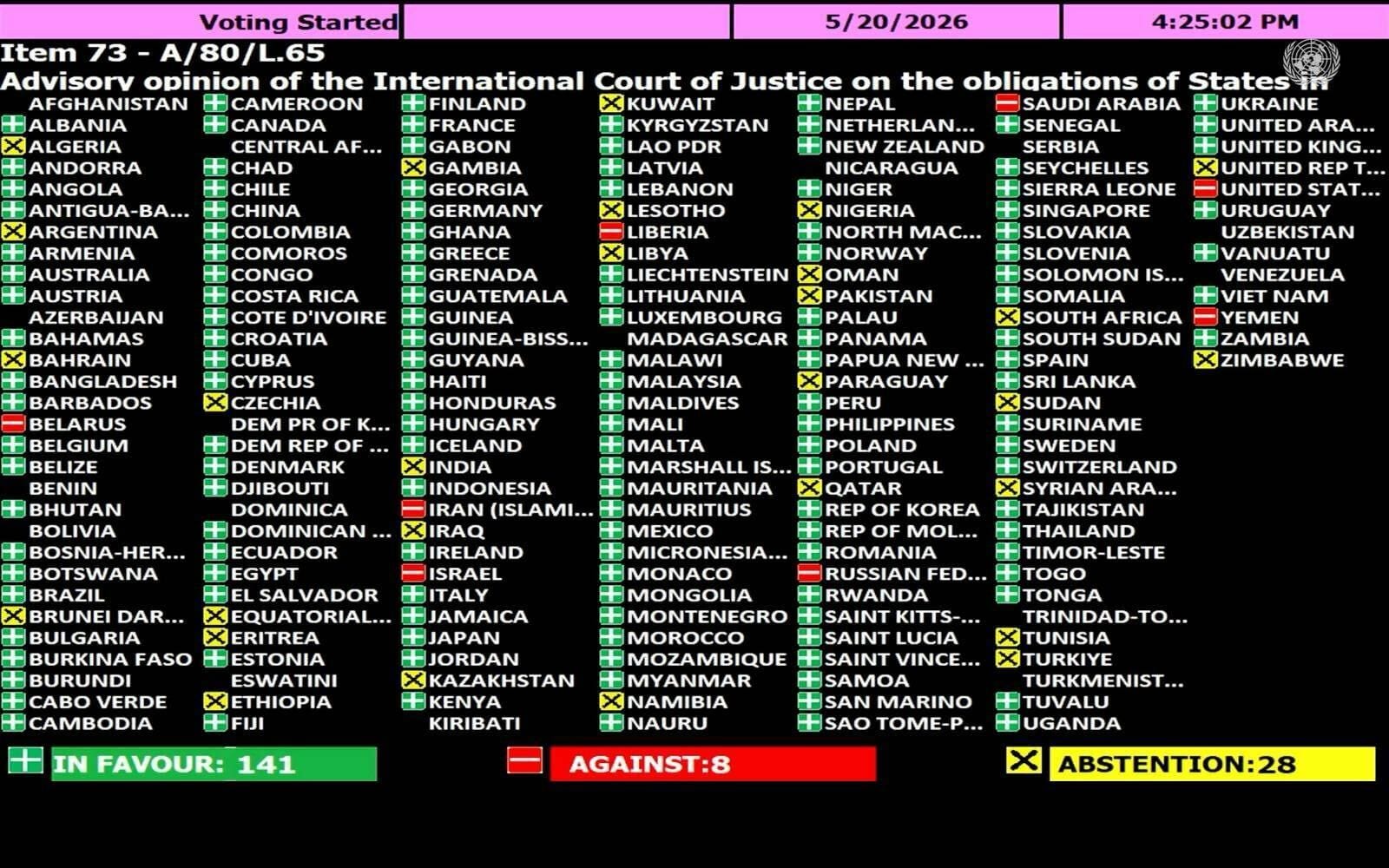
141 member states have signified their stated commitment to meaningful climate action; set against a small, although powerful, group of 8 states openly opposed to the ICJ's findings. In that group of opposing states are, not surprisingly, petrostates such as Saudi Arabia, Liberia and Iran, but also the United States, whose representative in the UN did not hold back in the US executive's criticism of both the draft resolution and the ICJ Advisory Opinion itself:
The resolution includes inappropriate political demands relating to fossil fuels and on other climate topics, and we believe there is no basis for the resolution’s mandate to the Secretary-General to report on the complex and nuanced legal issues addressed by the Court.
It's significant diplomatically, because this is another example of what are often thought of as less powerful small states, including small Pacific Island states, having a major impact on world affairs on climate change. It confirms, if there was any doubt, that small island states, including Pacific states, are a diplomatic and legal force to be reckoned with in international climate change law and policy. It sets the stage for further Pacific leadership, including Fiji and Tuvalu's role as hosts of the 'pre-COP' meetings in Suva later in 2026, with a special leaders' session taking place in Tuvalu.
And it's significant legally, because the content of the ICJ advisory opinion already being considered and applied by courts around the world now has a further boost with the UNGA's endorsement of it. The ICJ opinion is not enforceable in the same way that, for example, a judgment from the New Zealand High Court ruling on a dispute between two parties is enforceable. However, it is legally relevant to cases in courts around the world — in Canada, the Netherlands, Mexico and the European Court of Human Rights — already including references to the ICJ opinion in their judgments.
International lawyers have observed that courts around the world are treating the advisory opinion 'not as a remote statement of public international law, but as a live interpretive tool capable of shaping the content of domestic constitutional rights...' The 20 May resolution will add further weight to the ICJ's judgment and, in my view, increases the likelihood that domestic courts will refer to it, and perhaps, be influenced by it.
Where did New Zealand stand on the resolution?
New Zealand has navigated its way carefully through this process, holding its cards close to its chest until right before the vote. It ultimately sided with the majority, but also made clear in an intervention that its endorsement should not be seen as signalling that it agrees with everything in the ICJ's opinion. Ahead of the vote, the New Zealand representative Shannon Tau prefaced New Zealand's remarks explaining the government's decision to support the proposal with a statement:
This resolution does not fully reflect New Zealand’s position on the legal issues addressed by the International Court of Justice. Nor does it reflect all of the views expressed by the Court.
A similar position was taken by Australia. Both countries evidently considered the need to go on record as not accepting all of the ICJ opinion's content. In New Zealand's case this is probably not unexpected, given both the content of its representative's submissions before the ICJ (PDF), and the coalition government's current approach to climate change issues, both in New Zealand and internationally.
The vote may put governments who have supported the UN General Assembly resolution such as New Zealand and Australia in an interesting position where they are sued in domestic courts. It could create a conundrum for government lawyers whose Ministers instructing them have (through the government's representatives) internationally endorsed the ICJ opinion, but wish to downplay its significance in domestic proceedings. It remains to be seen how the New Zealand High Court addresses the ICJ opinion in its forthcoming decision on a challenge to the government's emissions reduction plans, heard in Wellington a few weeks ago. It will be even more interesting to see how government lawyers address the ICJ opinion in their submissions in the forthcoming Supreme Court case, Smith v Attorney-General, set down for a three-day hearing in Auckland on 17–19 August 2026.